
Why Your Car Pulls to One Side While Driving
Why Does Your Car Pull to One Side?
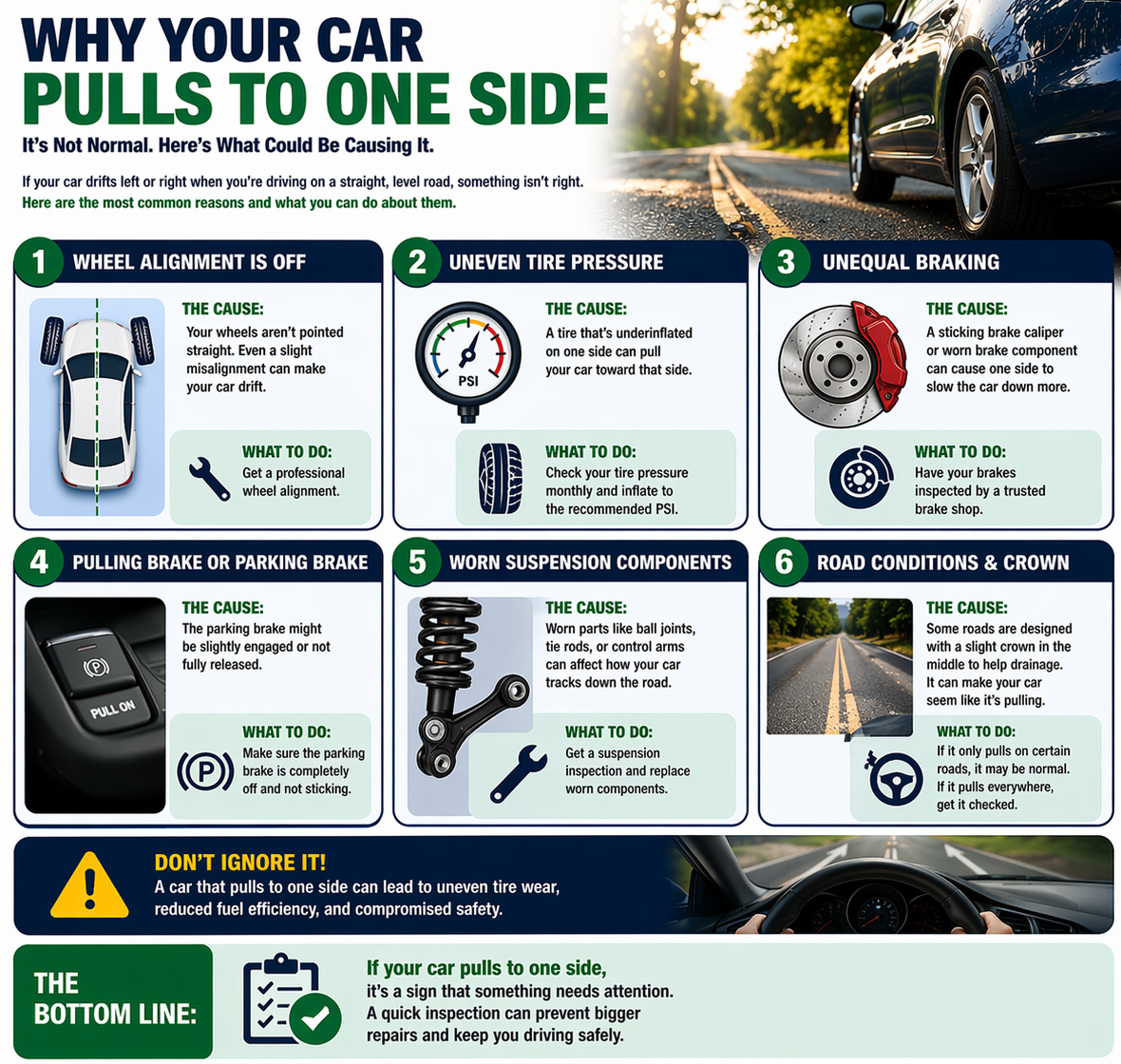
If your vehicle drifts left or right while driving, requires constant steering correction, or feels like it’s fighting against you on the highway, something isn’t working correctly. While many drivers assume it’s just an alignment issue, a car that pulls to one side can be caused by several different systems including the tires, brakes, suspension, steering components, or even a failing wheel bearing.
The good news is that most pulling problems can be diagnosed and repaired before they become major safety concerns. The bad news is that ignoring them often leads to accelerated tire wear, reduced fuel economy, poor handling, and more expensive repairs down the road.
Understanding what causes a vehicle to pull can help you identify the problem early and avoid unnecessary damage.
Wheel Alignment Problems
Improper wheel alignment is the most common reason a vehicle pulls to one side.
Your vehicle’s suspension is designed to keep the wheels positioned at precise angles as you drive. These angles, known as camber, caster, and toe, determine how the tires contact the road surface. When one or more of these angles falls outside factory specifications, the vehicle may begin drifting left or right even when the steering wheel is centered.
Alignment problems often develop gradually. A hard impact with a pothole, curb, railroad crossing, or road debris can knock the suspension out of specification almost instantly. Worn suspension parts can also cause alignment settings to change over time.
Common symptoms include:
- Vehicle drifts on a straight road
- Steering wheel sits crooked while driving straight
- Uneven or rapid tire wear
- Reduced handling stability
- Steering feels less responsive
Because alignment issues affect tire contact with the road, they can significantly shorten tire life and reduce overall driving safety.
Tire Pressure Differences
A surprisingly common cause of pulling is uneven tire pressure.
When one tire contains less air than the others, it develops greater rolling resistance and a different contact patch. The vehicle naturally wants to move toward the side with the lower-pressure tire.
Even a difference of just a few PSI can affect steering feel and cause a subtle pull, particularly on vehicles with sensitive steering systems.
Pressure changes can occur because of:
- Seasonal temperature fluctuations
- Slow leaks
- Punctures
- Aging valve stems
- Improper maintenance
Checking tire pressure should always be one of the first steps when diagnosing a pulling vehicle because it’s simple, quick, and often overlooked.
Uneven Tire Wear and Tire Defects
Not every pulling issue originates in the suspension.
Tires themselves can create directional pull if they wear unevenly or develop internal damage. A tire may appear perfectly normal from the outside while experiencing internal belt separation or structural failure that affects how it rolls.
Common tire-related causes include:
- Feathered tread wear
- Cupped tires
- Internal belt separation
- Mismatched tire sizes
- Different tread patterns
- Uneven tread depth
- Recently replacing only one tire
Tire pull can sometimes be diagnosed by rotating the front tires side to side. If the vehicle begins pulling in the opposite direction, the tires themselves may be the source of the problem.
Brake Problems That Cause Pulling
If your vehicle pulls only while braking, the issue is often within the brake system.
Your braking system should apply equal stopping force to both sides of the vehicle. If one brake caliper sticks, a brake hose restricts fluid flow, or brake pads wear unevenly, one side can generate more braking force than the other.
The result is a noticeable pull when slowing down.
Signs of a brake-related pull include:
- Pulling occurs only during braking
- Steering wheel jerks when stopping
- Vehicle feels unstable during hard braking
- Burning odors from a wheel area
- Uneven brake pad wear
Because braking performance directly affects vehicle safety, brake-related pulling should be inspected as soon as possible.
Suspension and Steering Component Wear
Many persistent pulling problems can be traced back to worn suspension or steering components.
Your suspension keeps all four tires properly planted on the road while maintaining alignment geometry. When parts begin to wear, the wheels can move in ways they weren’t designed to.
Components commonly involved include:
- Tie rod ends
- Ball joints
- Control arms
- Control arm bushings
- Strut mounts
- Sway bar links
- Steering rack components
In some cases, a vehicle may receive a wheel alignment yet continue pulling because worn suspension parts allow the alignment settings to change while driving.
This is why a complete suspension inspection is often necessary before performing an alignment.
Wheel Bearing Problems
Wheel bearings are another frequently overlooked cause of pulling.
A worn wheel bearing can create excessive play in the wheel assembly, affecting alignment angles and tire contact with the road. In severe cases, the vehicle may drift or feel unstable, especially at highway speeds.
You may also notice:
- Humming or growling noises
- Noise that changes during turns
- Steering wander
- Vibration through the steering wheel
Because wheel bearings affect both handling and safety, unusual noises should never be ignored.
Road Crown and Torque Steer
Sometimes the vehicle isn’t the problem.
Most roads are intentionally built with a slight slope, known as a road crown, to help water drain away from the driving surface. As a result, many vehicles will drift slightly to the right on certain roads.
Front-wheel-drive vehicles may also experience torque steer during hard acceleration. This occurs when unequal forces are transmitted through the drive axles, causing the steering wheel to pull momentarily.
However, these conditions should be temporary and relatively minor.
If the vehicle consistently pulls in the same direction on multiple roads and at various speeds, there is likely a mechanical issue that requires attention.
Can a Car Pull to One Side After New Tires?
Yes cars can pull to one side after new tires are installed.
New tires can sometimes reveal pre-existing alignment problems that worn tires had been masking. In other cases, slight manufacturing variations between tires can create a condition known as radial pull.
If your vehicle begins pulling immediately after tire installation, the alignment, tire pressures, and tire condition should all be inspected.
Is It Safe to Drive a Car That Pulls to One Side?
A slight pull may not seem serious at first, but it often indicates a problem that will worsen over time.
Driving with a pulling vehicle can lead to:
- Rapid tire wear
- Reduced fuel economy
- Longer stopping distances
- Poor handling in emergency situations
- Increased suspension wear
- Loss of vehicle control in severe cases
The earlier the cause is identified, the less likely it is to result in expensive repairs.
How Professionals Diagnose a Pulling Vehicle
Because multiple systems can cause similar symptoms, professional diagnosis typically involves more than a simple alignment check.
Technicians often perform:
- Digital wheel alignment measurements
- Tire pressure verification
- Tire condition and tread inspections
- Suspension component inspections
- Steering system evaluations
- Brake system testing
- Wheel bearing inspections
- Road testing
This process helps identify the root cause rather than simply treating the symptoms.
Trust Kinney’s Tire & Auto Service for Accurate Diagnosis
If your vehicle pulls left or right while driving, don’t assume it’s just an inconvenience. Whether the cause is tire wear, improper alignment, suspension damage, brake issues, or steering component wear, addressing the problem early can help protect your tires, improve safety, and prevent more costly repairs.
At Kinney’s Tire & Auto Service in Hurst, TX, our technicians use advanced diagnostic equipment and years of hands-on experience to identify the exact cause of pulling and handling issues. If your budget does not allow for a large repair at this time, don’t delay reapirs, as this can make them more expensive in the long run. Instead, we offer affordable and fair financing options for car repairs in Hurst TX that will help you get back on the road. From wheel alignments and tire services to brake repairs and suspension diagnostics, we’ll help restore the safe, predictable handling your vehicle was designed to deliver.