
Should You Change Your Oil Before a Fall Road Trip?
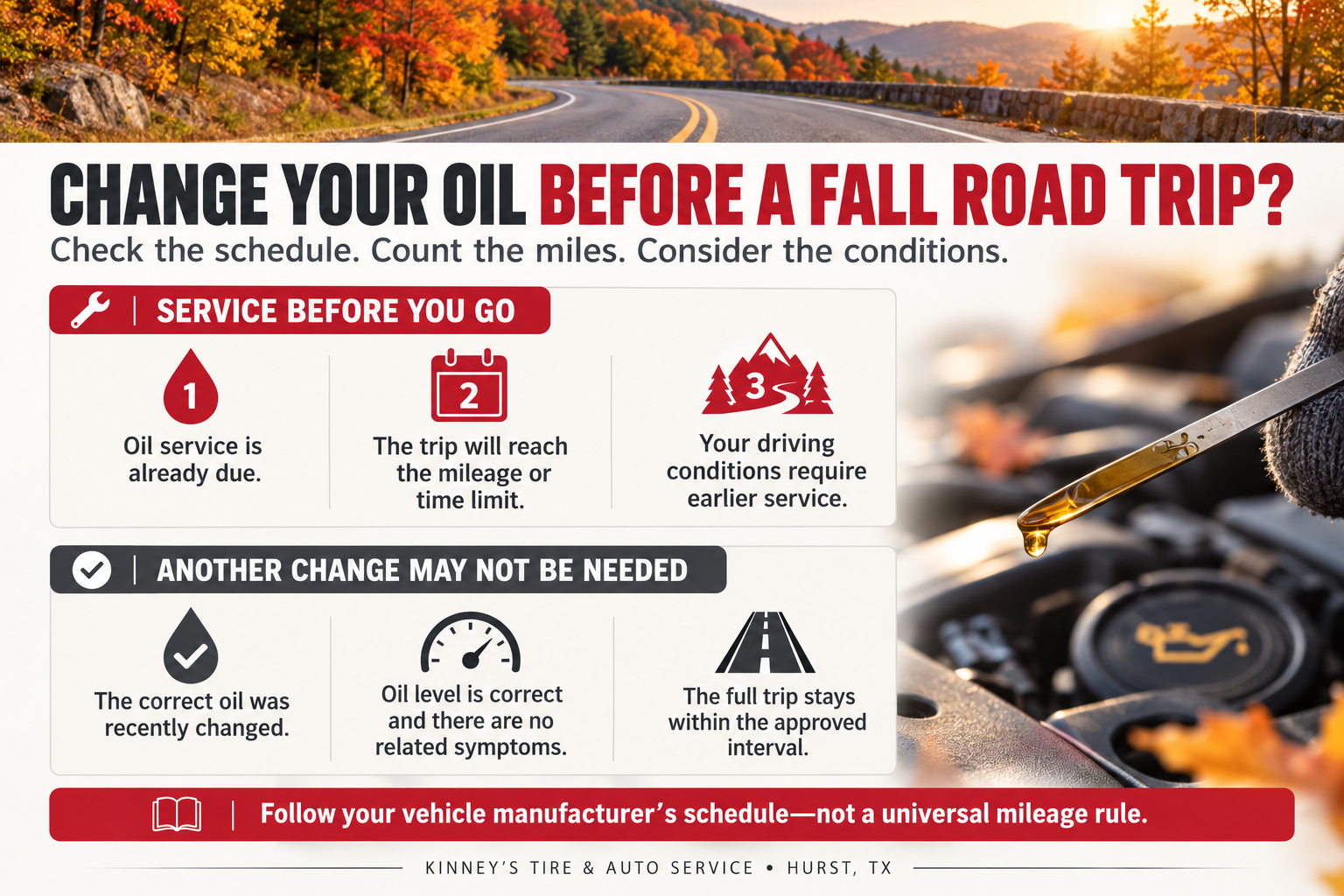
Change your oil before a fall road trip if it is due, will become due during the trip, or your vehicle’s operating conditions require service sooner. If the oil was recently changed, the level is correct, and the vehicle has no related symptoms, a trip does not automatically require another oil change.
Road-trip preparation often turns into a last-minute checklist.
Pack the car, fill the tank, choose the route, and decide whether there is time for an oil change.
A better decision starts a little earlier.
You need to know when the oil was last changed, what interval applies, and how much driving the trip will add.
For Hurst drivers, a fall trip might involve a short weekend away or a much longer drive into colder weather. Towing, mountain roads, and time spent idling can also change the maintenance discussion.
The goal is to leave with a vehicle that is ready for the actual trip—not simply with fresh oil and several unchecked problems.
Start With Three Questions
First, when was the last oil change?
Second, what does the manufacturer require for your vehicle and driving conditions?
Third, how many miles will the trip add?
If you cannot answer the first question, review the service records or contact the shop that performed the work.
Do not rely solely on memory or an oil life display that may have been reset incorrectly.
Once the history is clear, compare the remaining interval with the complete travel plan.
Oil manufacturer Mobil’s road trip checklist similarly emphasizes checking both oil level and service timing before departure. Source: Mobil
Count More Than the Outbound Mileage
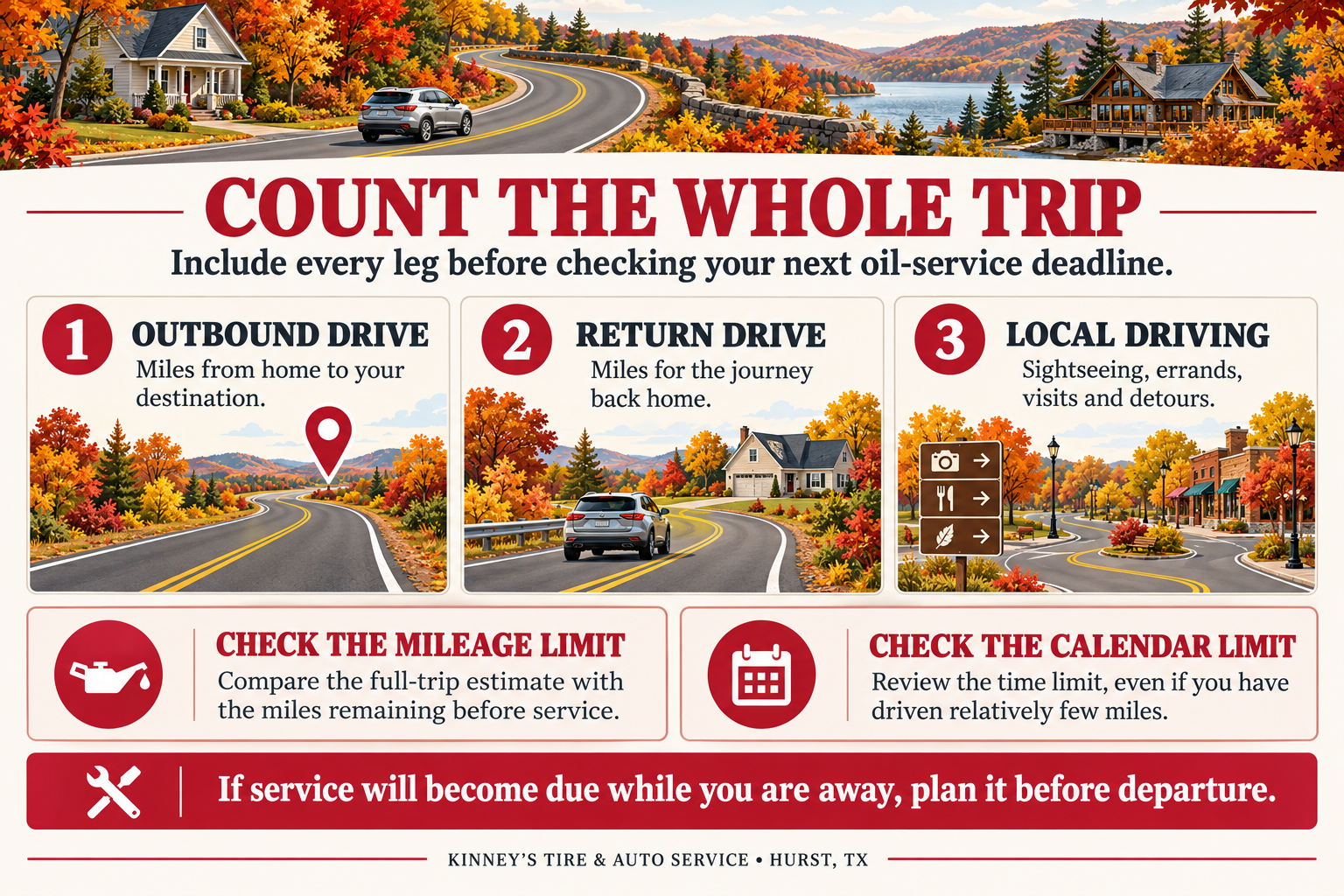
Drivers often calculate the distance to the destination and forget the return trip or local driving.
Include the full round trip.
Add realistic mileage for sightseeing, errands, visiting family, or detours.
Then compare that estimate with the vehicle’s next service requirement.
If you have 1,000 miles remaining before service and expect to drive 1,800 miles, servicing beforehand is usually more convenient than have it come due while away from home.
If you have ample interval remaining and the vehicle is operating normally, another oil change may be unnecessary.
The decision should follow the numbers.
Remember the Calendar Limit
Low mileage since the last service does not always mean the oil can remain indefinitely.
Many schedules include a time limit.
A vehicle driven only occasionally may become due by the time it reaches the mileage threshold.
Check both.
If the next service date falls during the trip or shortly before it, arrange service with enough time to address any findings.
Do not assume a long highway drive will erase months of short-trip operation.
When Changing Oil Before the Trip Makes Sense
An oil change is a reasonable pre-trip step when the vehicle is already due.
It also makes sense when the trip will take you beyond the required interval.
Other reasons can include an uncertain service history, an unsuitable oil previously used, or a maintenance schedule that changes due to the intended use.
For example, regular towing may trigger different requirements.
A mechanical problem may also require oil replacement as part of a repair, although an oil change alone will not necessarily solve the problem.
Kinney’s oil change service in Hurst can help you determine the right oil and schedule before you leave.
When Another Oil Change May Not Be Needed
If the oil was recently changed with the correct product, the level is appropriate, and the full trip stays within the approved interval, changing it again may offer little practical benefit.
That does not mean skipping preparation.
Check the level, review other maintenance, and inspect the vehicle for any symptoms.
A recent oil change does not confirm tire condition, brake performance, or battery health.
Use the available time to address the vehicle’s actual needs rather than repeating a service simply because a road trip feels demanding.
Does a Long Trip Wear Out Oil Faster?
Not necessarily.
Steady highway driving can be less demanding in some respects than repeated cold starts and short trips.
However, the details matter.
Towing, high loads, steep grades, extreme temperatures, and prolonged idling can increase demands.
A road trip can also expose a problem because the engine runs for much longer than it does during ordinary local use.
The trip itself is not a universal reason for a shorter interval.
The operating conditions are what matter.
What If You Are Towing?
Review the manufacturer’s towing-related maintenance requirements.
A trailer changes the workload on the engine and other systems.
Do not focus only on oil.
Check tires, brakes, cooling-system condition, towing equipment, and the trailer’s own maintenance.
Confirm that the vehicle and trailer are loaded appropriately and that the required service is current.
If the oil interval changes under towing conditions, use that interval for planning.
Tell the shop what you intend to tow and how far.
Check Oil Level Before Departure
The oil level and oil change timing diff.
A vehicle can be within its interval and still be low because of consumption or leakage.
Check the level using the owner’s manual procedure.
If you add oil, use the required product, and avoid overfilling.
If the level has dropped unexpectedly, investigate the cause.
Do not assume carrying extra oil makes an unexplained loss suitable for a long trip.
A stable, known consumption pattern and a sudden change are different situations.
What If the Oil Looks Dark?
Dark oil alone does not establish that it must be changed before travel.
Oil can darken during normal operation.
Likewise, light-colored oil does not prove that it has an unlimited service life.
Use the service schedule and history.
If the oil appears contaminated or there are other symptoms, arrange an inspection.
The decision should not depend on a color comparison with fresh oil.
Do You Need Different Oil for Cooler Weather?
Usually, you should continue using the manufacturer’s specified grade.
Do not switch to a different viscosity solely because the trip is in the fall.
Some manuals permit alternatives under particular ambient conditions, but those instructions are vehicle-specific.
If you are traveling into much colder weather, verify that the oil already installed is approved for the expected conditions.
The same principle applies to coolant and washer fluid: Use the correct products, not assumptions based on color or season.
How Far in Advance Should You Schedule Service?
Leave enough time for follow-up if an inspection finds a problem.
Several days before departure is often more practical than the final hour before leaving, though the right lead time depends on the work and parts availability.
After service, pay close attention while driving.
If a new leak, warning, or unusual sound appears, contact the shop before the trip.
An oil change typically does not require a special break-in drive, but scheduling early allows time to address unexpected issues.
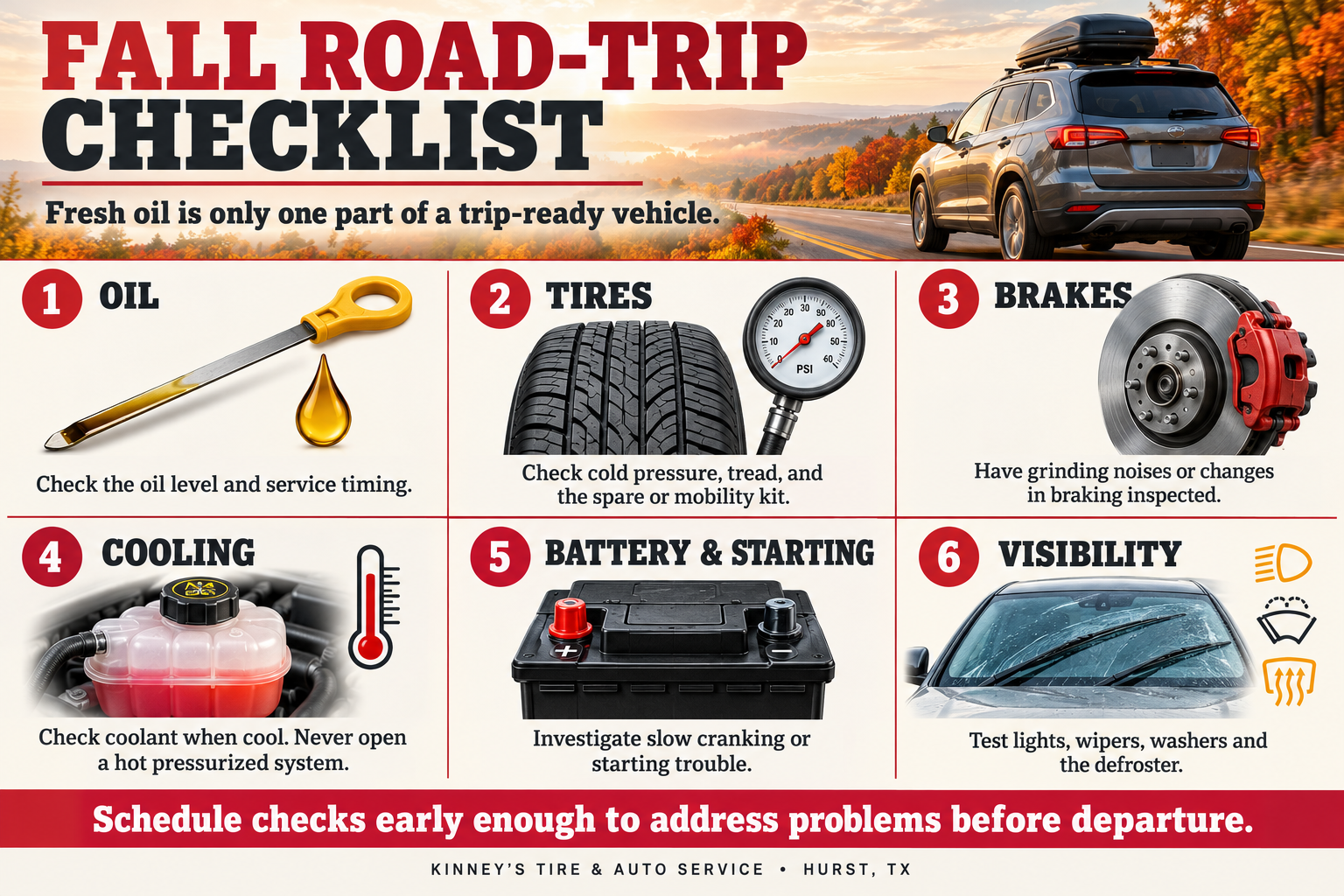
Tires Deserve Equal Attention
Check cold inflation pressure using the vehicle placard.
Inspect the full tread width for cuts, bulges, cracks, embedded objects, and uneven wear.
A tire with adequate tread can still have structural damage.
If the vehicle has a spare, check its condition and pressure. If it uses a mobility kit, inspect the equipment and sealant expiration date.
Kinney’s tire services can help address rotation, inspection, repair, and related needs before travel.
Do not begin a long trip with a recurring pressure loss that remains unexplained.
Have Brake Symptoms Evaluated
A road trip is not the time to test whether a grinding noise will disappear.
Mention pulling, vibration, a soft pedal, or changes in stopping performance.
The cause may involve pads, rotors, calipers, hydraulic components, or another system.
A proper inspection should identify the issue rather than automatically replacing one part.
Kinney’s brake service in Hurst can help evaluate those concerns.
If braking performance is significantly impaired, arrange service before driving further.
Check the Cooling System
Long trips can expose cooling-system problems that were less obvious during brief local drives.
Review coolant level and service history.
Check only when it is safe and in accordance with the owner’s manual. Never open a hot pressurized cooling system.
Repeated coolant loss, a rising temperature gauge, or a history of overheating needs attention.
Fresh engine oil does not repair a cooling system fault.
If towing or traveling through demanding terrain, the cooling system deserves particular attention.
Do Not Ignore Starting Problems
A slow crank at home may become a no-start at a hotel or roadside stop.
Battery condition, terminals, starter operation, and charging system performance can all matter.
A battery replacement is not automatically the answer to every starting issue.
Describe the symptom and when it occurs.
Intermittent problems can be harder to reproduce, so useful details help the shop select the right tests.
Prepare for Rain, Darkness, and Fog
Fall travel can involve earlier sunsets and variable weather.
Check headlights, brake lights, turn signals, wipers, and washer operation.
Clean the windshield inside and out.
Test the defroster and ensure adequate airflow.
If you are traveling in freezing conditions, confirm that the washer fluid and other relevant systems are prepared for them.
Visibility maintenance is easy to postpone because it may seem minor in dry daylight. It becomes much more important during an unfamiliar nighttime drive.
Should You Carry Extra Oil?
If the manufacturer recommends carrying oil or the vehicle has a documented consumption pattern, carrying the correct product may be useful.
Store it securely.
However, extra oil is not a repair kit for a vehicle losing oil rapidly.
Also carry basic roadside information, a phone charger, and equipment appropriate to the route.
Know how to respond to warning lights.
If an oil pressure warning appears while driving, safely stop and switch off the engine. Do not continue simply because extra oil is available.
What to Do During the Trip
Check the vehicle at sensible intervals, especially on a long journey.
Look for new fluid spots, unusual smells, warning messages, or changes in handling.
If the vehicle requires oil level checks during travel, follow the specified procedure rather than checking immediately after parking, when conditions are inconsistent.
If you notice a new symptom, address it before it becomes more severe.
A small delay for inspection can be preferable to continuing until the vehicle cannot move.
Fall Car Care Goes Beyond the Oil Change
Use the Car Concepts fall car care checklist to review the entire vehicle before departure.
The most useful plan covers maintenance that is due, symptoms that need diagnosis, and equipment that should be checked.
For some vehicles, that includes an oil change. For others, the priority may be tires, brakes, or an unresolved starting issue.
The checklist should reflect the vehicle you are taking and the conditions you expect.
Frequently Asked Questions
Should I change the oil for a 500-mile trip?
Only if the vehicle is due, will become due, or has another reason for service. The trip distance alone does not determine the answer.
Is it better to change oil before or after a trip?
If service is due during the trip, changing the oil before is usually more convenient. Otherwise, follow the established schedule.
Can I drive a little beyond the interval?
Do not build the trip around an unofficial extension. Plan service according to the manufacturer’s requirements.
Does a recent oil change mean the car is ready?
No. Tires, brakes, cooling, battery performance, and other systems still need consideration.
Should I reset the reminder before leaving?
Only after the appropriate service has been completed. Resetting the reminder does not improve the oil.
Prepare for Your Trip at Kinney’s
A good pre-trip decision combines service history, expected mileage, and an honest assessment of the vehicle’s condition.
Schedule an oil change at Kinney’s Tire & Auto Service when it is due, and mention any other concerns before you leave Hurst.
Preparing early gives you time to address the right issues and spend less of the trip thinking about what might have been overlooked.