
How to Tell When You Need New Brakes: Warning Signs, Brake Pad Wear, Rotor Problems, and When to Stop Driving
Brake wear usually develops gradually, making it easy for drivers to adjust without realizing performance has changed. You may begin braking earlier, tolerate a mild vibration, or assume an occasional squeal is normal.
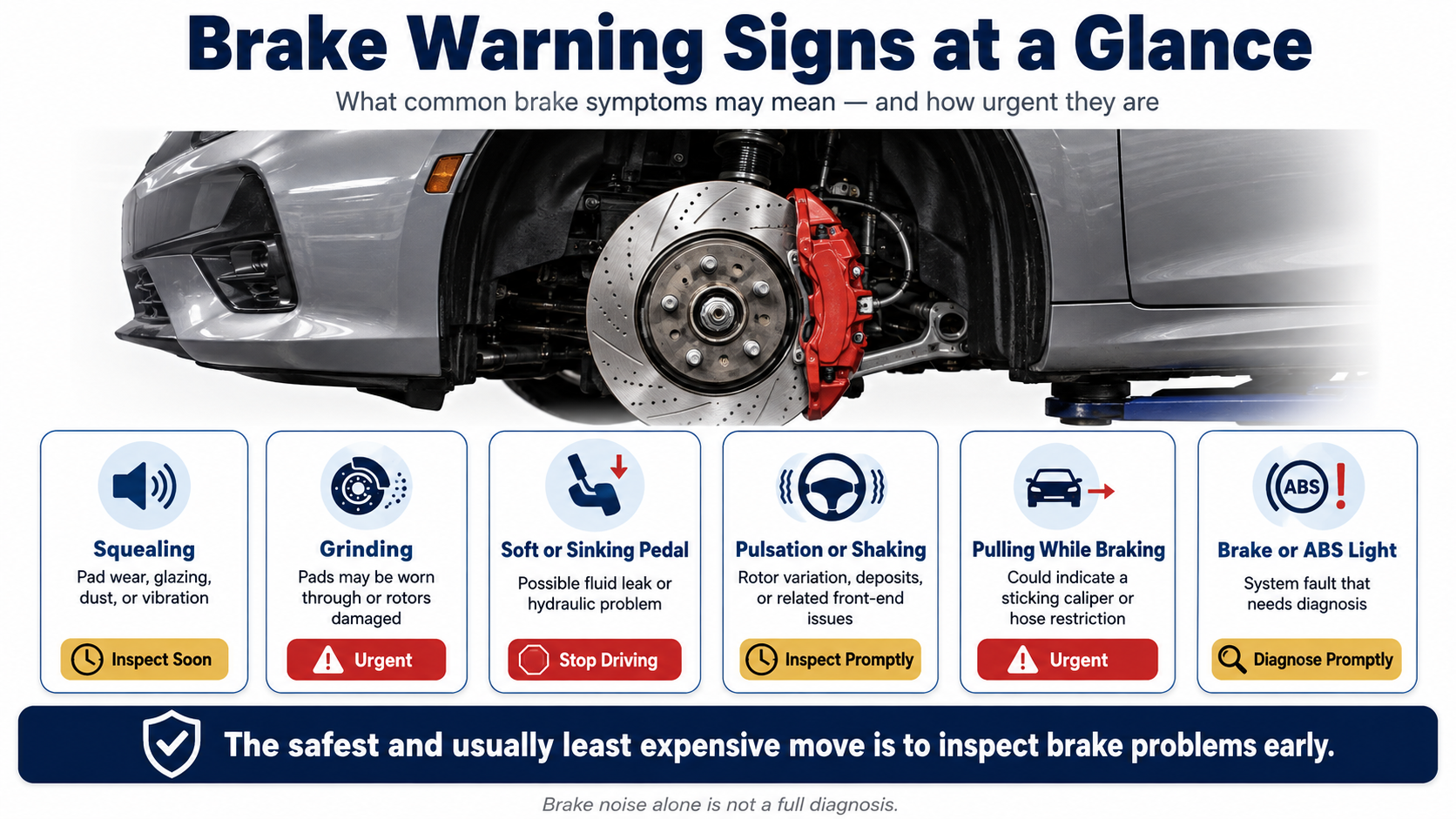
Common warning signs include squealing, grinding, longer stopping distances, vibration while braking, pulling to one side, a soft or sinking pedal, burning odors, fluid leaks, and illuminated brake or ABS warning lights.
These symptoms do not always mean that only the brake pads need to be replaced. The problem may also involve the rotors, calipers, brake fluid, hoses, master cylinder, brake booster, wheel-speed sensors, or other parts of the braking system.
Brake Warning Signs at a Glance
| Symptom | What it may mean | How urgent is it? |
| High-pitched squealing while braking | Brake-pad wear indicator, glazing, contamination, or vibration | Schedule an inspection soon |
| Grinding or harsh scraping | Pads worn through, damaged rotor, debris, or failed hardware | Stop unnecessary driving and inspect immediately |
| Soft or spongy pedal | Air, fluid leak, deteriorated hose, hydraulic fault, or overheated fluid | Urgent |
| Pedal slowly sinks toward the floor | Master-cylinder bypass or hydraulic leak | Stop driving and arrange service |
| Vehicle takes longer to stop | Worn pads, overheating, contamination, fluid problem, tires, or another fault | Urgent |
| Pedal pulsates during braking | Rotor thickness variation, runout, deposits, ABS operation, or loose components | Inspect promptly |
| Steering wheel shakes while braking | Front brake rotor, wheel, suspension, or steering problem | Inspect promptly |
| Vehicle pulls during braking | Sticking caliper, contaminated pad, hydraulic restriction, tire, or suspension problem | Urgent |
| Burning smell or smoke near a wheel | Dragging brake, seized caliper, overheated pads, or parking brake problem | Stop and allow the vehicle to cool; arrange service |
| Red brake warning light | Parking brake applied, low fluid, hydraulic fault, or other brake-system problem | Stop safely and investigate immediately |
| ABS light | Anti-lock braking fault; ordinary braking may remain but without normal ABS operation | Schedule diagnosis promptly |
| Brake-fluid leak | Failed hose, line, caliper, wheel cylinder, master cylinder, or fitting | Do not continue driving |
| Electronic pad-wear warning | Pad sensor has reached its wear threshold | Schedule brake service soon |
| Clicking or clunking while braking | Loose hardware, worn suspension, caliper movement, or damaged components | Inspect promptly |
The table is a starting point rather than a diagnosis. Several different failures can create similar symptoms, and one vehicle may have more than one problem at the same time.
Squealing Brakes: Does the Noise Mean You Need New Pads?
A high-pitched brake squeal can indicate worn pads, especially when a built-in metal wear indicator contacts the rotor or an electronic sensor triggers a dashboard warning. Persistent squealing should be promptly addressed, as continued driving may damage the rotors.
However, squealing can also result from moisture, surface rust, dust, glazed pads, poor-quality materials, damaged hardware, corrosion, vibration, new-pad bedding, performance pads, or road debris. A brief morning squeak may be harmless, but noise that persists, worsens, or turns into grinding should not be ignored.
Grinding Brakes Usually Require Immediate Attention
A harsh grinding noise often indicates that the friction material has worn away and the metal pad backing plate is contacting the rotor.
At that point, the repair may no longer be limited to brake-pad replacement. Metal-to-metal contact can rapidly score, overheat, and reduce the rotor’s usable thickness.
Continued driving may also:
- Increase stopping distance
- Overheat the caliper
- Damage the caliper piston
- Damage brake hardware
- Generate excessive metal debris
- Create severe vibration
- Increase the possibility of losing braking effectiveness at that wheel
Grinding can have other causes. A stone may become trapped between a dust shield and a rotor. A backing plate may be bent. A wheel bearing can fail. A parking-brake shoe can break apart inside a rear rotor assembly.
The practical rule remains the same: grinding should be inspected immediately.
Do not continue driving for several weeks because the vehicle still stops. A relatively ordinary pad-and-rotor service can become a caliper, rotor, hose, and hardware repair when metal-to-metal braking is allowed to continue.
Kinney’s brake service includes inspection of pads, rotors, calipers, brake lines, fluid, and related components, so the source of the noise can be identified before parts are selected.
Scraping That Happens Even When You Are Not Braking
A scraping sound that continues while driving, even when the brakes are not applied, may indicate a dragging brake caused by a sticking caliper, seized hardware, restricted hose, parking-brake problem, corrosion, or trapped debris.
A dragging brake creates excessive heat and may cause pulling, sluggish performance, uneven wear, smoke, or damage to nearby components. Do not touch an overheated wheel or brake assembly, and have the vehicle inspected promptly.
A Soft or Spongy Brake Pedal Is Not Normal
A brake pedal should feel firm and consistent. If it suddenly becomes soft, spongy, or travels farther than normal, the cause may be air in the lines, a fluid leak, a failing master cylinder, overheated fluid, improper bleeding, a damaged hose, or another hydraulic or mechanical problem.
A pedal that improves when pumped still requires inspection. Pumping may temporarily compensate for air, excessive brake clearance, or adjustment problems, but it is not a permanent repair.
A Pedal That Sinks While You Hold It Down
A particularly serious symptom is a pedal that initially feels firm but slowly moves toward the floor while steady pressure is maintained.
This may indicate:
- Internal master-cylinder bypass
- External hydraulic leak
- ABS hydraulic unit fault
- Fluid boiling after severe overheating
Inside the master cylinder, seals must hold pressure within separate hydraulic circuits. If fluid bypasses the seals internally, the pedal can continue moving even when no obvious external leak is visible.
A sinking pedal should not be treated as ordinary pad wear. It is a potential hydraulic failure.
Do not continue driving to see whether it improves. Arrange for a professional inspection or towing.
A Brake Pedal That Feels Harder Than Normal
A very hard pedal can also signal a problem.
The braking system may still function, but the driver may need substantially more force to stop the vehicle.
Possible causes include:
- Failed vacuum brake booster
- Vacuum leak
- Damaged booster hose
- Failed vacuum pump
- Check-valve problem
- Electromechanical brake-assist fault
- Hydraulic restriction
- Engine problem reducing available vacuum
- Ice or mechanical obstruction around the pedal linkage
Many gasoline vehicles use engine vacuum to multiply pedal force. Diesel, turbocharged, hybrid, and electric vehicles may use separate vacuum pumps or electronically controlled brake boosters.
A hard pedal accompanied by a much longer stopping distance is unsafe. The brakes may technically operate, but require more force than the driver can reliably produce in an emergency.
Longer Stopping Distance Is a Major Warning Sign
Brake wear is not always noisy. A vehicle that takes longer to stop or requires more pedal pressure may have worn, overheated, contaminated, or glazed brakes, a hydraulic or booster problem, or a brake that is not applying correctly.
Stopping distance also depends on tire traction, road conditions, vehicle load, and ABS performance. Any noticeable changes in stopping distance should prompt a professional inspection.
Vibration or Pulsation During Braking
A pulsating pedal is often described as a “warped rotor.”
That description is common, but several different rotor conditions can create the symptom:
- Disc thickness variation
- Lateral runout
- Uneven friction material transfer
- Heat spots
- Corrosion
- Rotor damage
- Improper wheel-lug torque
- Hub rust or contamination
- Loose wheel bearing
- Worn suspension or steering components
As the rotor rotates, variations in thickness or position can push the caliper piston back, creating a repeating pulse through the brake pedal.
A steering wheel that shakes mainly during braking often points toward a front brake, hub, wheel, or suspension concern. A pulsation felt more strongly through the body or seat may involve the rear brakes, though this distinction is not absolute.
Bosch lists rotor scoring, uneven wear, corrosion, excessive heat, and component movement among conditions that can produce braking noise, vibration, and reduced efficiency.
Pulsation should be diagnosed rather than automatically treated with new pads. The technician may need to measure:
- Rotor thickness
- Minimum allowable thickness
- Thickness variation
- Lateral runout
- Hub runout
- Wheel-bearing play
- Caliper operation
- Suspension looseness
The Vehicle Pulls to One Side While Braking
A vehicle that changes direction when the brakes are applied may have uneven braking force from side to side.
Possible causes include:
- Sticking caliper
- Seized caliper slide
- Contaminated pad
- Restricted brake hose
- Air in one hydraulic circuit
- Uneven pad wear
- Leaking caliper or wheel cylinder
- Brake adjustment problem
- Tire-pressure difference
- Tire damage
- Worn suspension component
- Alignment problem
- Road crown
A pull that appears only during braking is more suggestive of a brake problem than a vehicle that pulls continuously. However, tire and suspension conditions can affect both.
Kinney’s offers steering and suspension repair and four-wheel alignment service in addition to brake repair. This is useful when pulling, vibration, or uneven tire wear cannot be explained by the brake components alone.
A strong or sudden pull is unsafe, especially during emergency braking. Have the vehicle inspected promptly.
The ABS Warning Light
The ABS light indicates a problem with the anti-lock braking system.
ABS monitors wheel speed and rapidly adjusts brake pressure when a wheel begins to lock up while braking. This can help preserve steering control under many emergency conditions.
When only the ABS light is illuminated, conventional braking may remain available, but the anti-lock function may not operate normally. Ford’s owner guidance states that a vehicle can retain ordinary braking with an ABS fault while losing anti-lock functionality.
Possible causes include:
- Failed wheel-speed sensor
- Damaged sensor wiring
- Corroded tone ring
- Wheel-bearing problem
- Low system voltage
- Blown fuse
- Hydraulic-control-unit fault
- ABS pump failure
- Brake fluid problem
- Communication fault
An ABS light does not automatically mean you need brake pads. It requires diagnostic testing.
Kinney’s provides automotive diagnostic service and ABS brake-system diagnosis as part of its brake-service capabilities.
Uneven Brake-Pad Wear
Pads on the same axle should not have dramatically different thickness without a reason.
Uneven wear may indicate:
- Sticking caliper slides
- Seized caliper piston
- Restricted brake hose
- Corrosion around pad hardware
- Improper installation
- Bent caliper bracket
- Contaminated friction material
- Electronic parking-brake fault
- Excessive rotor runout
A new pad set installed without correcting the cause may wear unevenly again.
Bosch recommends checking calipers whenever brake work is performed because blocked pistons, damaged seals, and movement problems can cause one-sided or tapered pad wear.
Kinney’s digital vehicle inspection process can document visible differences in pad thickness, rotor condition, leaks, and related concerns with photographs or video.
When Do Brake Rotors Need Replacement?
Brake rotors are not replaced solely because the pads are worn.
A rotor may need replacement when it is:
- Below the minimum thickness
- Heavily scored
- Cracked
- Heat damaged
- Severely corroded
- Unevenly worn
- Creating excessive pulsation
- Contaminated
- Damaged by metal-to-metal contact
- Unsuitable for resurfacing
The minimum thickness is usually cast or stamped into the rotor and listed in service information. A technician uses a micrometer to measure the rotor at several points.
Rotor thickness matters because the rotor must absorb and release heat while maintaining structural strength.
A rotor that has become too thin may:
- Overheat more quickly
- Distort
- Crack
- Provide insufficient piston support
- Fall below specification after resurfacing
- Reduce the system’s heat capacity
Some rotors can be resurfaced if they remain thick enough, are not damaged, and the manufacturer permits machining. Others are replaced because machining would leave them too thin, or replacement is more practical.
Bosch recommends inspecting the rotors whenever pads are replaced and installing new pads whenever rotors are replaced.
What Brake Calipers Do—and How They Fail
The caliper converts hydraulic pressure into clamping force.
A floating caliper must move on slides so both pads apply evenly. Fixed calipers use multiple pistons and remain stationary over the rotor.
Caliper problems include:
- Piston seizure
- Slide-pin corrosion
- Torn dust boot
- Fluid leakage
- Damaged seal
- Frozen bleeder screw
- Uneven movement
- Electronic parking-brake failure
A sticking caliper may produce:
- Pulling
- Uneven pad wear
- Hot wheel
- Burning smell
- Poor fuel economy
- Vehicle that does not roll freely
- Rapid rotor damage
- Smoke
- Brake fade
A caliper should not be replaced only because a pad is worn. The technician should verify the failure through movement, temperature, wear pattern, hydraulic testing, or leakage.
Brake Noise That May Not Mean Immediate Replacement
Not every sound indicates a dangerous failure.
Temporary noises can result from:
- Light surface rust
- Rain or humidity
- Dust
- Cold temperature
- Car-wash moisture
- New pads bedding into the rotors
- Aggressive pad compounds
- Long vehicle storage
The distinction is duration and pattern.
A brief scraping sound during the first stop after rain may be surface rust. Grinding that continues after several stops is different.
A performance-oriented pad may squeal during light braking but perform correctly under heat. A family sedan that suddenly begins squealing after years of quiet operation deserves inspection.
When uncertain, have the brakes measured. Noise alone cannot tell you how much friction material remains.
Brake Inspection and Repair in Hurst, TX
You should not have to wait for the brakes to grind before scheduling service.
Early signs such as persistent squealing, mild pulsation, uneven wear, a change in pedal feel, or a brake warning message provide an opportunity to inspect the system before the repair becomes more extensive.
The most important warning signs are:
- Grinding
- Soft or sinking pedal
- Longer stopping distance
- Pulling
- Severe vibration
- Brake-fluid leakage
- Burning odor or smoke
- Red brake warning light
- Significant change in braking response
Kinney’s Tire & Auto Service provides brake inspections and brake repair in Hurst, TX, for pads, rotors, calipers, brake fluid, hydraulic components, parking brakes, and ABS concerns. Kinney’s brake page states that its technicians inspect pads, rotors, calipers, lines, and fluid, and can perform pad replacement, rotor service, caliper repair, brake fluid service, and ABS diagnosis.
Related services include:
- Digital vehicle inspections
- Automotive diagnostics
- Steering and suspension repair
- Four-wheel alignment
- Vehicle safety inspections
- Tire installation and inspection
- Factory-scheduled maintenance
- Auto repair financing
- Current service offers
Kinney’s Tire & Auto Service is located at 624 East Pipeline Road in Hurst, Texas, and currently lists weekday hours from 7:30 a.m. to 5:00 p.m.
A brake noise does not always mean the entire braking system must be replaced. It does mean the vehicle is giving you information.
The safest and usually least expensive response is to have the brakes inspected while the problem is still small, measurable, and repairable, before worn friction material becomes damaged rotors, overheated calipers, or reduced stopping ability.